Seriously, do NOT try to “fix” your friends/family members/aquaintances who are disabled or chronically ill (whether physically or mentally or otherwise or both)!
Accomodate them. And accept that they might not get better, they might get worse. Don’t get frustrated at them. Don’t expect that your presence or kindness or (worst of all) unwanted advice will “fix” them. Just be there, accomodate them, and accept them and breathe. Relax. It’s not your job to “fix” anyone and neither is it their responsibility to magically get better for your sake or to comfort you.
(reblogs appreciated)
Tag: actuallyautistic
disabled people shouldnt have to downplay their disability for the comfort of abled people
Let’s talk about the astounding similarities between cats and autistic people, and how we should make them the official autism mascot instead of that godawful puzzle piece
Oh man, now you’ve got me going!
Firstly, cats stim. They purr, swish their tails and knead their paws against pillows, blankets, and other soft things. Many cats actively seek out sensory experiences, like listening to birds singing, lying in a sunbeam, rolling against the grass, etc.
Cats have sensory sensitivities— many of them dislike walking on certain flooring, touching certain textures, and certain smells or sounds may make them anxious. Their fur is very sensitive, they can sense the lightest touch, or speck of lint, or dust and their skin will quiver until they can lick or rub it off. When they become overstimulated cats retreat into a small, dark place to recover.
Cats love routine. Many cats know the exact time that their owners wake up in the morning and will wake them. A cat with a routine is a happy cat— they love to have their meals or soft food on a schedule and will learn their owner’s schedule. Cats will become anxious when the schedule is disrupted or if their owner doesn’t follow their usual routine.
In the same vein cats are very wary and/or anxious when it comes to the introduction of new things or people into their environment. Cats require time and patience to get used to anything or anyone newly introduced. Cats also feel anxious when existing furniture is rearranged or when a new smell (like an air freshener) is introduced into the home.
Cats often have “special interests”, a particular activity or thing that they love and can spend hours enjoying. It could be playing with a particular toy, chewing on something, listening to the radio, or watching the clothes in the washing machine. My cat Kitty has a certain ball that she fixates on and will happily enjoy and obsess over for hours.
Finally, cats have a very distinct and subtle body language. The difference is particularly evident when compared with the exuberant, unsubtle dog. The slightest twitch of a tail or turn of the ears, the frequency and timing of blinks, and the positioning of the tail in relation to the body are all little movements that can express much. To the untrained eye it may appear as if a cat is bored, aloof, or unaware of its surroundings. But once you learn to recognize cat body language and understand cat communication, you’ll be amazed at the depth of emotion and how expressive your cat really is.
Yes, I think that cats have a lot in common with autistic people. And that’s wonderful!
Dear parents of autistic children,
No, your child doesn’t do weird things “for no reason”. They do it for a reason, you just don’t know it yet. You have different brains, different perspectives, so sometimes things that are obvious to them are a mystery to you. But you don’t have to ignore it and blame it on them. You can make an effort, reach out to them and figure out the reason.
Do they scream in public when it looks like everything is okay? Well, there’s probably a reason for that. Maybe the situation is overwhelming to their senses, it’s too loud, to bright, to crowded, and they need some space and time to recover. Maybe they can’t stim because other people keep telling them it looks weird, so they end up exhausted much faster. Maybe you are breaking their routine by being outside at this time. Or maybe you are going through the supermarket “the wrong way”, not how you usually do it. Maybe they forgot their comfort object at home, and just realized that. Maybe they are in pain and can’t communicate that. Maybe they are very hungry and don’t realize that yet because it’s hard for them to recognize their needs and emotions. Maybe it’s a combination of those, or something different altogether.
Either way, they probably don’t do it “for no reason”. You just don’t see the reason. Make an effort to communicate. If they are verbal, ask them. If they can’t speak with their mouth at the moment or ever, use alternative methods of communication. If they can’t explain it, consult other autistic people, including autistic adults who probably have a bunch of ideas as to why your child does that weird thing. Don’t dismiss it, don’t complain about it, don’t blame your child for doing it. Try to see the world from their perspective. Respect their needs and feelings. Learn more about autism from other autistic people.
And life will be much better and easier for both you and your child.
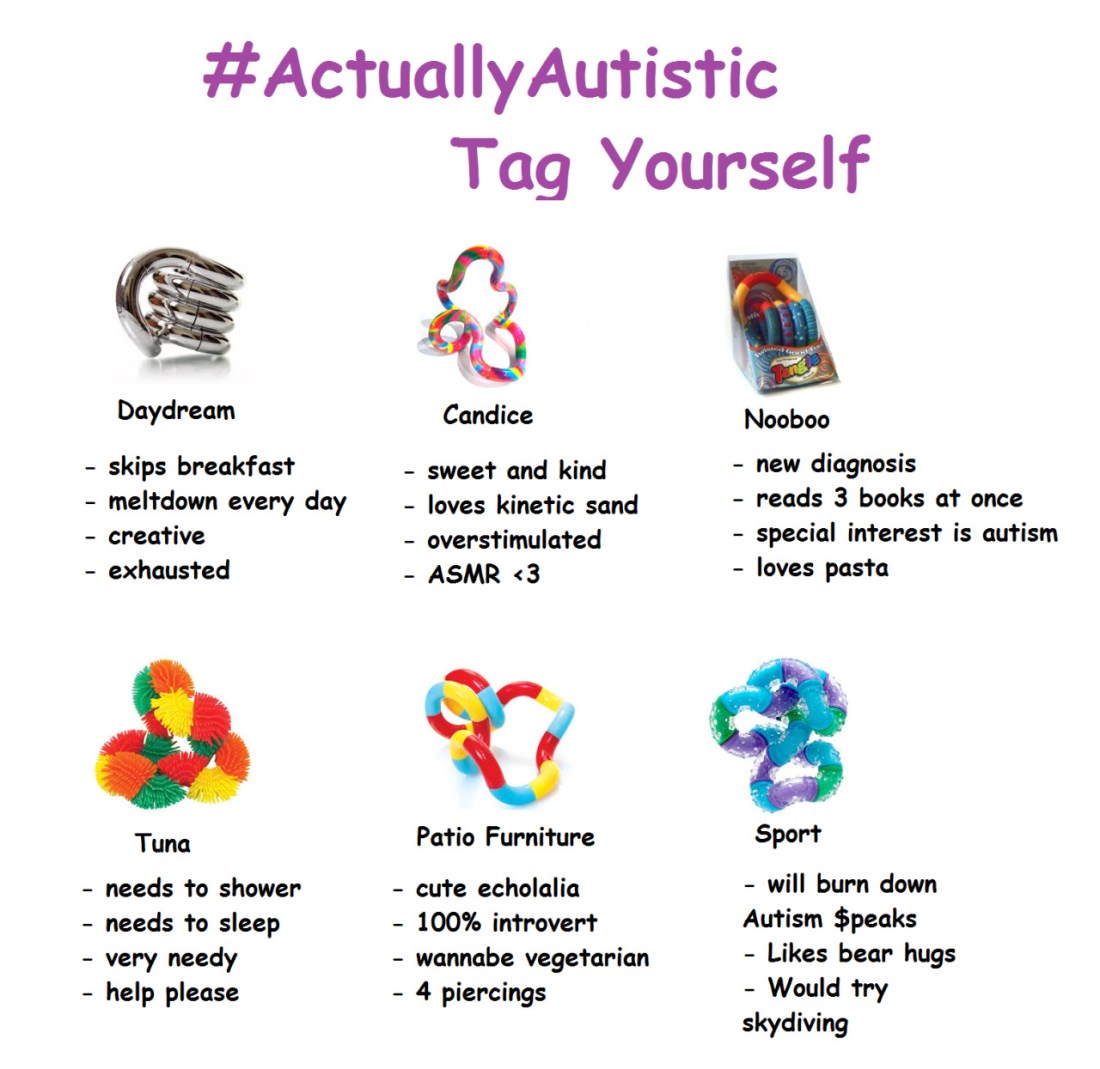
My first TAG YOURSELF was so much fun to make that I decided to make another Tag Yourself meme for the autistic community. If you like these, please let me know. I’d be open to making more. Or make your own and tag me!
 ruby-dear archive