Things they don’t tell you about special ed kids: they’re probably being that “disruptive” or “reclusive” because the sped teachers literally abuse them and no one gives a fuck. (It’s literally legal for sped teachers to abuse their students because it’s considered part of the special ed therapy.)
When I was in middle school, I was in a special ed program called “Social Thinking”, which was supposedly for teaching social skills, but really what it taught was “You have to act like a normal (neurotypical) person and only ever do ‘expected behavior’, or everyone will hate you and think you’re annoying. You have to always keep up this facade no matter how exhausting it is. If you don’t do that and just be yourself, your friends would be happier without you.”
Some highlights from that special ed class:
The teacher told me, to my face, that all my teachers hated me and thought I was annoying and stupid, and that this was because I blurted out in class.
They literally went to my friends behind my back and told my friends to stop listening and walk away from me anytime I started “monologuing” aka rambling about the things I’m interested in. (My best friends decided not to do that, because they knew how awful the teachers were.)
One of my best friends was also in that sped program, and one year she was in the same “class” for it as I was. I cried in that class a lot, but she cried even more than I did. She also had breakdowns (as did I) and was suicidal sometimes. I distinctly remember one time when she said “Just give me the scissors, I’ll do it right now!”. She was TWELVE at the time.
The teacher would frequently grab my chin and turn my head towards her, forcing me to make eye contact. She also told my parents to require me to make eye contact before allowing me to do fun things, and to force eye contact like that if I didn’t want to. (And, unfortunately, they did.) Even now, almost five years later, I still flinch when anyone comes close to touching my face.
I’m pretty sure I got some form of ptsd from all the horrible in that special ed therapy, but I can’t get it diagnosed because even the possibility of having to talk to any sort of therapist makes me have severe panic attacks. :^) lifes a bitch like that.
TLDR: special ed teachers were super abusive and no one gave a shit because it was supposedly part of the therapy.
“I feel like I’m working towards my death. The constant demands on my time since 5th grade are just going to continue through graduation, into college, and then into my job. It’s like I’m on an endless treadmill with no time for living.”
“How long is your child’s workweek? Thirty hours? Forty? Would it surprise you to learn that some elementary school kids have workweeks comparable to adults’ schedules? For most children, mandatory homework assignments push their workweek far beyond the school day and deep into what any other laborers would consider overtime. Even without sports or music or other school-sponsored extracurriculars, the daily homework slog keeps many students on the clock as long as lawyers, teachers, medical residents, truck drivers and other overworked adults. Is it any wonder that,deprived of the labor protections that we provide adults, our kids are suffering an epidemic of disengagement, anxiety and depression?”
Reblogging because, speaking as an autistic person, most of my meltdowns at school came from homework.
Math homework in particular, which gives me the hypothesis that the time we spend teaching math at levels far above what students are going to need in their daily lives and the amount of homework accompanying such is a part of the problem…
Yeah my time in education taught me that homework is kind of a waste of everyone’s time. It can’t be relied on for assessment/evaluation purposes because there’s no reliable way for a teacher to know the student didn’t copy off of someone else, and it can’t be used for instruction because the student works on it when the teacher isn’t around to give, well, instruction. Like standardized testing, it’s basically a pointless relic of a very outdated model of education that America and other countries still cling to because adapting modern techniques costs more money, time, and effort than they’re willing to give.
Down with homework.
I know we’re talking about the kids here, but speaking as someone who trained to be a teacher but is no longer a teacher for mental health reasons: homework also puts a huge strain on the teachers. That shit needs to be marked. As well as the class work. In the bigger schools a single teacher can have hundreds of students. As a trainee I had roughly 200. And they all produced work that needed marking. You end up using up your non-teaching periods – earmarked for sorting out the next classes, preparing future work etc – and a lot of it ends up getting marked during lunch breaks and/or is taken home.
I remember one of my fellow trainees took two entire boxes of work to mark home with him for the weekend. The weekend!
There are a lot of initiatives being put in place or being tried out for reducing marking time (only do every other book! Only tick or cross! Use prewritten feedback! Use stamps! Etc) and this always struck me as completely fucking pointless. If the student isn’t getting good helpful tailored personal feedback – what the fuck is the point?
The homework eats up both the students non-school time and the teachers. It causes extra stress for both. It causes extra anxiety for both.
It’s fucking ridiculous. So basically what I’m saying is that I agree. Homework should be abolished.
If there are any other teachers out there still hanging on, may I recommend watching a video for homework? You can’t really prove they haven’t done it, and things like Khan Academy are great for students who want to pause and re-wind information and can’t do that during a class. It shouldn’t be anything new, just re-capping what you did in class. And if anyone in senior management calls you on it, you can talk about review of learned content strengthening the neural pathways to the memory making it more accessible in the long run, and shifting information from the short term to long term memory centres of the hypothalamus (senior management at my old school were all humanities teachers, whenever I felt spiteful I would blind them with very earnest science…)
Our school used to ask children who were late questions about maths, but those that they can’t answer yet. And then they made kids write down that they don’t know math. My 11yo classmate (who was always great at math) was crying after this.
Oh god, my elementary school was hell.
I remember this one music teacher who, for some reason, REALLY fucking hated autistic kids. I would know, because everyone in my weird therapy group was targeted while everyone else was ignored.
I saw her physically drag a kid out and threaten to get him suspended because he was to scared to dance solo in front of his peers.
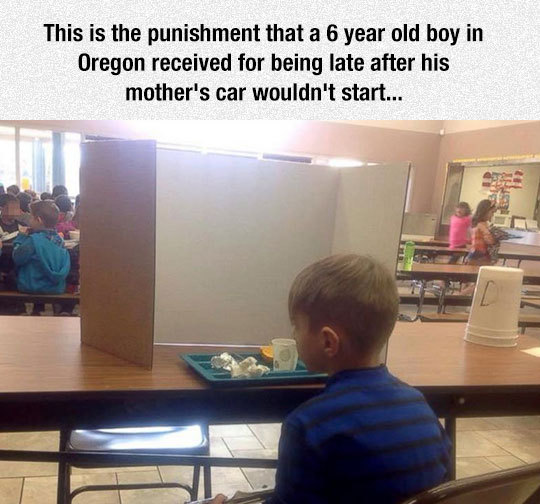
There was also “lunch detention,” and they didn’t fuck around with that. They didn’t isolate the students like that, they fucking shoved them in a separate room and forbade them from sitting together or talking. They slowly brought in several teachers and eventually the principal, and they all, one by one, told us that we were horrible, reprehensible people who would never be successful.
And you wanna know HOW you got lunch detention? Not finishing your work on time, even if it was a one-time thing.
State sanctioned child abuse
‘Child abuse’
Y’all are insane.
It may not be child abuse but honestly, some of this shit is fucking insane and harmful to the students than it is helpful.
I was given 52 detentions for suspected cheating, almost suspended for it. The principal called me to his office, made some cheesy annoying statement about how this kind of behavior wouldn’t be tolerated.
Okay, I said. I’m sorry, it won’t happen again. It was a mistake.
Already that year I knew three people who were out longterm for mental illness. Already kids were high in classes just to get by them. Already what was tolerated was a bunch of kids having breakdowns.
It was a mistake it won’t happen again. I make sure that my answers are big on the science test. The boy next to me can’t afford medication for his learning disability and hasn’t slept since his parents split and if he doesn’t get a 2.0 he loses his team, the last thing he has left.
It was a mistake it won’t happen again. When I pass her my homework I ask her quietly if her mom was getting better. When the semester ends and we are in different classes, I start doing her assignments on the side. She sends me snaps from chemotherapy.
It was a mistake it won’t happen again. When I hand over the notes, I make sure there’s plenty of marginal positive thoughts. They haven’t smiled all month. I know what it’s like to be too tired and doing nothing at all.
It was a mistake. Your students are resorting to immoral choices because they have no other option. You make grades the be-all and end-all priority, no matter what else might be happening. You force them into situations where they can either fail and definitely have a permanent punishment, or cheat and probably pass – it’s worth the risk. Your students stand in solidarity, not to praise the might of learning: but to gather together in the right of living. You are the one who made the dichotomy of student/human. We are not both, are given “either like it or leave it”, are trained almost like robots. Do the work, don’t ask questions, don’t challenge the authority.
It was a mistake. It won’t happen again where you can see it. But I love learning. And if I can be the one who keeps your student in the classroom by giving them that extra push? Maybe I’m doing a better job than you. Cheating wouldn’t be a problem if we weren’t already being cheated. You can’t set us up to lose and then get frustrated when we rig the game, too.
I Was Always On Green Because My Mama Didn’t Play That Shit.
I got a Red for the first time ever cause I launched a basketball at this girls face 😭😭 it was an accident tho I swear lmao
This traumatized so many kids. I knew someone who had no memory of this until I said the phrase “go flip your card” and suddenly they remembered everything
I went from green straight to red because I gave my friend a piggyback ride for like five seconds
America are y’all okay..?
We had to move popsicle sticks into a green, yellow or red can.
I had to move mine to yellow once for “talking out of turn”.
Literally never spoke up in class again.
This is seriously some fucked up shit, jfc.
it’s funny, because it works as a very effective means of discipline/reinforcement. the concept is simple: instead of the teacher disrupting the whole class and stopping teaching to deal with one person stepping out of line and being, themselves, disruptive, they tell you to go turn your card. then they carry on with the lesson while you do it. kidspawn’s school calls it a point out system. you get three warnings, then you have to log into a book. it takes attention away from the mistake and discourages acting out for that attention.
done properly, it puts the choice in the student’s hands. you know the consequence for an infraction, and you choose whether or not that consequence is worth your action. in a perfect setting, it would only be for actual rules, you spend less time talking to school authority figures, and parents wouldn’t flip out about it unless there was a string of repeated red cards. you don’t double punish, after all.
the best way not to get a red card is not to get a yellow card. it really does benefit everyone in a classroom setting if implemented and respected by all who use it. i find it strange that people find this ‘fucked up’. it’s not corporal punishment, which IS fucked up, and it keeps infractions from taking away from instruction time, robbing other students of their education. loss of instruction time is in no one’s best interest.
and in every setting i’ve seen it used properly (both as a student and as a parent) it works exactly like it’s intended to.
I am a teacher working toward my Masters in education, and I spent my entire kindergarten education and third grade (the only two years I had to suffer through a classroom with one of these boards) entirely on red. The Flip Your Card classroom discipline system is in fact unimaginably fucked up.
At first I worked really really hard to try to keep my card on green, or at least on yellow, but no matter how hard I tried, by the end of the day, my mom was getting a phone call all about how I was a problem. I was regularly stripped of every single privilege my teacher conceivably could strip me of. My third grade teacher gave up on taking away my recess because she just didn’t want to have to deal with me for that extra time, every single day. And every single day, there was a bright red card telling everybody, telling all the other kids, telling my parents, and telling me that I was a problem.
Here’s the thing, no matter how hard I tried, I couldn’t keep my card off red, so it wasn’t this behavior or that behavior that felt like the problem. It just felt like I was the problem.
I did what many kids in that situation do. I gave up. From the outside, it must have looked like I didn’t care that my card was on red, but in reality, I had given up on trying to keep it off red, because nothing worked. It wasn’t apathy. It was hopelessness and despair. In kindergarten, I just checked out and ignored the board. I flat out told my teacher that she could turn my card from then on, because I wasn’t going to. But in third grade, I hit on something worse. Instead of simply pretending the board didn’t exist, I responded to the realization that I couldn’t win by changing the perimeters of what winning was to me. If I was trouble and a problem, I was going to show everybody just how much of a problem I could be. Instead of winning because I made my teacher happy, I won by making everything into a power struggle. Yeah sure, I got sent to the principal’s office and my mom was called, but I didn’t do that thing my teacher wanted me to. Score one for me. That year, I went from difficult to hell on wheels.
This is not actually uncommon, and there are some very good sociological and psychological reasons for why I reacted the way I did. One of the most basic sociological principles is that of labeling theory. This is the idea that people go through life collecting labels, and that these labels affect how we act and how we function in society. People by and large live up to or down to the labels we are given. We can see this in the criminal justice system, where the ways in which we label and treat people, especially juveniles, who commit crimes greatly affects whether or not they will commit a crime in the future, in other words the more someone is treated as a criminal, the more they will act in criminal ways. In a similar manner, being told that you are a bad kid, a troublemaker, a problem, whether outright or through a card system, is liable to convince you of this fact and reinforce that problem behavior. This is one reason why Flip Your Card systems often worsen behavior problems in children with existing difficulties with classroom behavior.
Another failure of the Flip Your Card system is that it has no room for incremental improvement and does not promote reteaching of behavior on the part of the teachers who use it. Most kids with behavior difficulties in the age range where Flip Your Card systems are used are really struggling on learning the rules of behavior and how they should be reacting in a given situation, or learning emotional self regulation. In my case, I had a siezure disorder that wasn’t diagnosed until I was mid-way through third grade, that aside from being misidentified as behavioral problems also prevented me from learning appropriate behavior by damaging my ability to form memories during the period when they were untreated. I also have ADHD, which I can’t treat with medication, because all of them cause me to have siezures. I needed extensive reteaching, and a teacher who was willing to work with me in the moment to help me find better solutions to the situation I was responding to with bad behavior.
Likewise, Flip Your Card systems do not recognize incremental progress. I have a student who just last week refused to come inside when it started thundering, because he wanted to stay outside and spend time talking to his little brother through the fence between the toddler and preschool playgrounds. This is normal for him. Separation from his brother causes him a lot of stress. But I was able to get him to come inside with a little persuasion and a kiss from his brother, and as soon as we were inside, he washed his hands and went to the cozy corner to calm himself down. This is progress. This is in fact the kind of progress that I told his mother about with pride at the end of the day. Once he was calm, I also talked with him about how he should be proud of himself for using some of the skills he was working on to calm himself, and what we could have done differently together outside. Under a Flip Your Card system, his behavior was the kind where he would be required to flip his card to yellow, his progress ignored. What I did instead was to construct a label for him of a student who is working hard on behavior, and affirm for him that I can see the progress and effort he has made. I also established us as partners in helping him reach behavioral and social emotional goals.
Another problem with things like the Flip Your Card system is that much like zero tolerance systems, or any system that are supposed to make things fairer by taking out teacher judgement is that they do not in fact take out teacher judgement. One of the big discussions right now in computing is that the way in which algorithms for job searches or hiring software, or worse algorithms for software used in the criminal justice system, are biased on racial and gender lines, both because of the algorithms themselves and because of the biased information fed into them. This is another example of that. A supposedly unbiased system that becomes very biased because of its nature and because of incorrect input. I already talked a little bit about how students with disabilities that affect their behavioral and social and emotional development are penalized by this system, but another factor is that disabled students, students of color, and especially disabled students of color, are much more likely to be asked to flip their card for behavior that would go unremarked upon for a white or non-disabled student. This is also true of so-called zero tolerance policies. This means that the toxic effects I outlined previously of labeling children as bad fall especially heavily on childen who are already especially vulnerable to being funneled into the school to prison pipeline.
Flip Your Card systems and other similar systems (and throughout this essay I talk about the Flip Your Card system, but Move Your Clip, Name on the Board, behavior charts, and all such similar systems are analogous) also do not promote student choice and autonomy as ouyangdan asserts. They are a classically behavioralist model of classroom management, one that functions on a system of reward and punishments. Reward and punishment systems increase student feelings of powerlessness and decrease their feelings of control. Giving a child a choice between a punishment and doing what you want them to is not giving them a real choice. It’s the same as a bully saying “give me your lunch money or I’ll beat you up, it’s your choice.” These behavioralist systems of classroom management also decrease students’ intrinsic motivation to behave, and replaces it with an extrinsic modivation. This can be seen in my case when my intrinsic modivation to try to behave for my teacher and my fellow students was overriden with the extrinsic modivation of the Flip Your Card board, which didn’t work because I gave up on avoiding the punishment. With my intrinsic motivation leached away and the extrinsic modivation proving ineffective… But this can also be seen in kids who behave well in class. Instead of learning the whys of good behavior and learning to regulate their emotions and reach consensus, and other skills of living in civil society, they learn that to be good is to be obedient and avoid punishment, to please the person In Charge. This is what happened with @thecityhorse higher up in this thread. They learned that speaking up in class brought pain, so they stopped, at a detriment to their education and their psyche.
So why are behavioralist approaches like the Flip Your Card chart so popular? One reason is that for most students they work in the short term very well. Humans like to avoid humilation and pain. This makes them convenient for teachers to implement, even if they cause other problems. Another reason is that they look fair to most adults even though they are not. Also it’s impossible to discount how thouroghly we as a society believe in certain ideas about a child’s place as obedient and subservient to adults, especially parents and teachers, and view enforcing this idea as a good in and of itself. Most people, even teachers, who absolutely should know better, and have in fact been learning better in teaching programs for decades, don’t step outside this paradigm. Behavioralist systems of reward and punishment reinforce this obedience.
Behavioralist approaches to classroom management are so normative that it can be hard to think about what the alternatives to them are, and when I talk to people about the alternatives to behavioralist methods, they express scepticism about the effectiveness of these methods. The biggest method I use is to get to the root of a behavior. Johnny screems during play, which causes Tommy to hit him. Tommy gets scared when Johnny screams in a way that seems aggressive, so we work on reading body language and what to do when we’re scared. Johnny screams because he gets wound up and overwhelmed playing chase, so we work on stopping and leaving the game before he gets that overwhelmed. I do a lot of teaching my students to recognize and name their own emotions, and recognize and name each other’s emotions, and think about what caused those emotions. I teach them ways to calm down, to get what they want and need in acceptable ways, and I build a relationship of mutual respect in which they want to do things for me and for their classmates because they care about us. This is that intrinsic motivation I talked about. And yes, many of the kids I work with have some pretty severe behavioral challenges. This was also the method that worked with me as a child. My fourth and fifth grade teachers both worked hard to develop relationships of trust and respect with me, and worked with me on processing my emotions and understanding the needs and feelings of others. This method really does work, and it promotes empathy, self-awareness, and moral self-reliance, which are important lifelong skills.
YES, all this.
The year I was in 5th grade, we had “the stick system,” which was a lot like this – you start each week with 5 sticks in a little pocket, and for every infraction you have to take one out and put it in a jar. If you ended the week with 5 sticks, you got a prize (a sticker or a piece of candy). With 4 sticks you didn’t get the prize, but there was this recess period on Friday afternoon that was like 1.5 hours long, and you got to have recess the whole time. For every stick after that, you lost some time in recess and basically you had to be in time out instead; you’d sit in a classroom quietly and do nothing for up to 90 minutes. Because the best thing to do with a kid who can’t behave is make them sit still and do NOTHING for a longer period than they can basically conceive of, instead of making them run in circles on the playground.
I was a very quiet, lonely kid; I have ADHD which was actually pretty debilitating as a kid. Basically I found it impossible to do anything except read novels and fight with my sister. So I would always lose my sticks for forgetting to do my homework, zoning out in class, being quietly and oddly disruptive… I never. EVER. had any sticks left at the end of the week. Actually I think once I ended the week with 1 stick, and I was SO proud of myself…and all the other kids usually ended the week with 4 or 5, so the teachers were like “ok so you failed slightly less than usual. Good job?? Now do your fucking homework.” (I paraphrase but that was basically the sentiment.)
The thing is, I was SO EAGER to be liked – by anyone! Classmates, teachers… my classmates just thought I was weird, but my teachers actually liked me most of the time, they just found me really frustrating. Which, fair: I also found myself really frustrating. One time my science teacher was collecting homework, and I (as usual) did not have it. So she gives me this completely fed-up look, and says, “Okay. Well…(sigh) go take a stick.” Completely done. And I have to tell her “I don’t have any sticks left.” She just stares at me for a few seconds, then literally throws her hands up and walks away. And I wanted to DIE. But I didn’t know how to react to that, so I was just stoic.
Maybe she thought I didn’t care, but it was just the opposite – I was this little 9 year old kid who constantly felt like the world was ending because I could never do anything right. I wanted so badly to be good, and I was incapable of doing what they wanted. But they still used the stick system with me, even when it was very clear that it had no effect on my behavior. To this day, I wonder why, after like a month of this technique completely failing to help me or them, they didn’t just scrap it and figure out something else. Was it too much work to teach me? Was it easier to just keep setting me up for failure?
Here’s the rest of that story: the next year, my 6th grade teacher told my mom I’d never graduate from high school (my mom was like “ok challenge accepted you bitch”. Good mom.) Two years later I was given a period of “resource room” every day (basically special ed) where I learned stuff like organization and study habits and refocusing when you zone out (WHAT?! MAGIC!) And then I graduated from high school, got into and graduated from a very good college, got a master’s degree, and then I decided to go into medicine so I took a bunch of science classes and got myself into medical school. Just started my 2nd year, and I did quite well last year so GO FUCK YOURSELF MS FISHER. I did TOO graduate from high school and guess what the fuck else! (…actually she’s probably dead by now so whatever).
My 5th grade teacher, though, the one who had the stick system? She really liked me and wanted me to succeed. She worked with me a lot, but either she didn’t know how to do it right or I wasn’t ready. But they never thought of stopping that stupid system. I still wonder what that year (and subsequent years) would have been like, if they hadn’t let me turn myself into the bad guy in my own life. You should never make a kid feel that crappy.
someone in your class mentions communism. they speak about it at length. you are in biology class.
you text your mother. she does not respond for 3 days. you text her again and then realize that it has only been 2 hours since your first text.
freshmen travel in packs. what are they afraid of.
your class is in room 153. the numbers start at 201. you cannot find the first floor.
someone is talking about communism. it is not the same person as last time. this is an english class.
your transcript says you have an A in philosophy 3310. you do not remember taking this class. what did you learn? what did you do?
you meet your elevator buddy. you do not speak. you never do. you ride in silence. one day, they are not there. you miss them.
your advisor refers you to the registrar. the registrar refers you to admissions. admissions refers you to both the registrar and your advisor. you have spoken to two people who do not exist and one who has been dead for ten years.
the boy who sits next to you wears the same clothes everyday. you think this is strange but when you mention it, he tells you that this is the first time he has worn this outfit. you realize that you have lived this day before.
you pass someone sleeping in the quad. he has always been there. stop looking at him.
someone answers, “communism.” it is not someone who has been previously mentioned. the question was, “what is an example of the art of ancient greece?”
you have a doppelganger on campus. you have never met them. they know all of your friends.
the seniors speak only to professors. their eyes are dead. they have given up the safety of the pack long ago.
the professor is talking about STD’s. your math class is very strange.
the powerpoint is in comic sans. you suspect that your economics professor is an extraterrestrial being after all.
“communism,” the man serving you lunch insists. wearily you nod. that’s what everyone says.
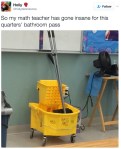
…But why do you need an object to go to the bathroom? Does it unlock the magic bathroom door?
a hall pass is a thing you can show to school staff to prove you’re wandering the halls with your teacher’s permission, not skipping class. once upon a time it was a piece of paper, but people kept losing those, so around the time i was in high school, teachers started taping the school-issued cardstock hall pass to things like blocks of wood, plastic flowers, and plush toys, to make them harder to lose.
apparently it wasn’t enough.
Also people would steal them so they could have a get out of jail free card if they got caught skipping class.
It’s a little bit easier to find a stolen giant pencil than it is to find a stolen hall pass
This is eaxctly why hall passes have gotten so extreme.
this is fucking surreal and only adds more weight to my theory that the american public school system is (barely) held together by a dark and arcane magic
when adults tell teenagers that the dull ache of high school is just a survivable mess that they’re making up to be worse than it is, i think of this:
when i was in sophomore year, i was in an accident and the left side of my face was hit. i sat in the emergency room with a clearly broken nose and blood coming out of a laceration on my cheek. and i did my homework. i did my homework with a black eye swelling up, with little red fingerprints on it.
and he told me to redo it. that it wasn’t good enough. the assignment itself was worth maybe five points out of a hundred. he wouldn’t forgive me for it. when i explained about my concussion, he told me to do it somewhere dark.
we don’t make it up. the value of our lives becomes almost nothing at all. the quality of living that is allowed is so low that students learn to apply it to themselves. they are useless, unimportant, a machine to figure out problems without any food, sleep, family time. nothing. we call teenagers moody because something in them breaks a little. we don’t say: they are stressed beyond measure and they believe their own physical health is less important than the quality of the product they’re forced to produce. we don’t say: wouldn’t you be moody too?













 ruby-dear archive