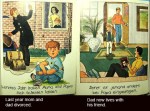
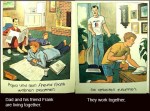
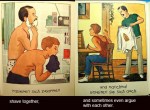
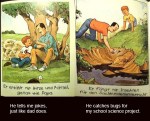
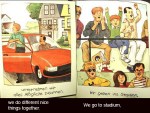
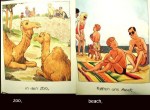
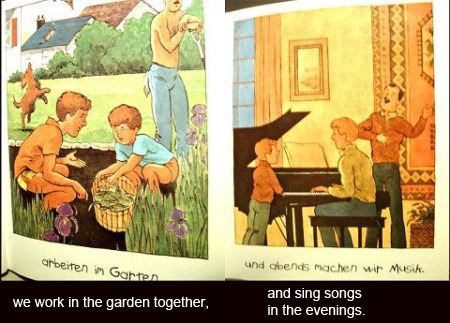
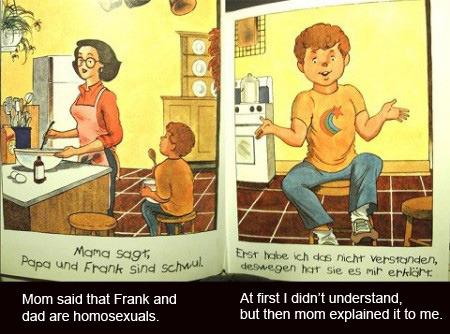
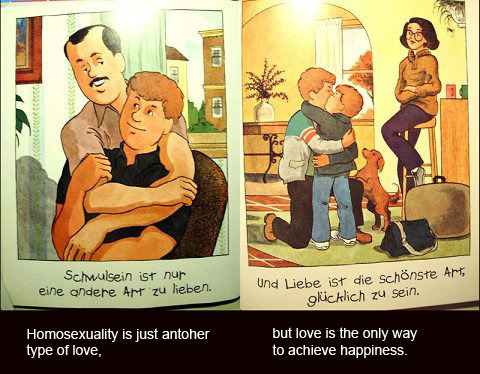
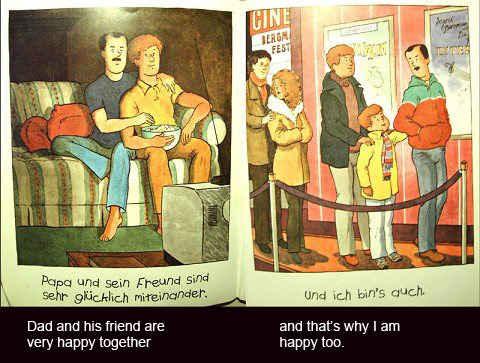
Homosexuality explained in a German Children’s Book
‘he tells me jokes, just like dad does’ so this poor kid has to put up with two, maybe three times the dad jokes
That book is called Daddy’s Roommate. And it is one of the books that gets destroyed the most in libraries, forcing libraries to have to purchase it again. That’s right–homophobes keep destroying it, forcing people to buy more copies, which in turn keeps it in print.
I think we really need to reaffirm now that no amount of homophobia can be acceptable in our culture. There is no such this as harmless or victimless homophobia. All homophobia contributes to violence against us. You can not “disagree” with lgbt people’s “lifestyles” without supporting the rhetoric and legislation that puts us in very real danger.
Homophobia isn’t that black and white though. You can hate the sin and still love the sinner.
OK, as a queer person who grew up in a genuinely loving, caring, utterly wonderful, and still deeply homophobic Church, let me try to fill in what you’re not understanding about this whole “Love the sinner” deal.
When we refer to people like you as “Homophobic” I want to be clear what we’re saying here. This is not a judgment of your intent. We are not describing you as a hateful person, as an aggressive or violent person. But we are saying that your actions and your attitudes participate in and reinforce a system of rhetoric that encourages violence against LGBT people, and, far, far more importantly, that forces millions of LGBT people to live in shame.
That’s really what this comes down to. Not hate. Not violence. Shame.
Consider the point purely theologically. Jesus tells us that to desire a sinful thing is as bad as to act on that desire. My lusting after another mans wife is as bad as actually sleeping with her. My genuine desire to hurt someone is as bad as actually hurting them.
So when you tell me that loving another man is a sin, you’re not just talking about physical acts of intimacy. You don’t get to draw the line there. You don’t get to pretend that I can be bisexual so long as I never actually physically act on it (which is already a terrible burden to place on someone). You’re saying that every time I look at a guy and imagine how soft his lips would be, or think about how beautiful his eyes are, I am sinning. I am a sinner every time a dude walks past me with a tight sweater on that shows of his arms. Every time he has nice hair or a nice smile.
My love, according to you, is a sin. That is the burden you are forcing people to live under. That burden forced me so deep into the closet that I didn’t even know I was there. It forced me to repress every genuine feeling of sexual attraction for other men, and to live for years with those feelings straining to get out, whilst I struggled with the constant guilt and shame that came from having those thoughts.
And I am one of the lucky ones, because I’m alive to have this conversation. Because for many, many LGBT people that guilt and shame manifests as self-harm, substance abuse, low esteem that leads them into abusive relationships, and very often suicide.
You tell yourself that you’re one of the good ones because you don’t hate us. You only hate what we “do”. But what we “do” is living. It’s being alive and whole and a part of this world, and if you genuinely believe that we can’t have that then you might as well put the gun to our heads and pull the trigger. Because you’re already doing that, you just don’t have the guts to admit it.
“You only hate what we do, but what we do is living” Wow. This is beautiful and so well written
reblogging for perfect commentary and future reference
Being straight is like being in gryffindor: all the main characters are always gryffindor, there’s tons of merch for gryffindor, and no one’s gonna give you shit for being in gryffindor.
Being gay is like being in slytherin: everyone has heard of it, but the merch is few and far between so you have to really want it. The only slytherin characters are secondary and morally gray. Some people think you are evil.
Being bisexual is like being in ravenclaw: there is no merch. there are no major ravenclaw characters. people definitely try to lump it in with either gryffindor or slytherin, and there are a few weird stereotypes.
oh my god i am obsessed with lgbt history too! here’s a list of some i myself have seen and enjoyed – i bolded my absolute favourites, in case you wanted maybe a recommendation of where to start! 😀
the celluloid closet (1995) – incredible doc about lgbt representation in the media starting all the way from 1900 to 1995, including censorship and the bury your gays trope.
paris is burning (1990) – critically lauded classic must-watch doc about drag balls and q*eer culture and the lgbt people of color who created it.
A documentary of the successful career and assassination of San Francisco’s first elected gay councilor. there is also the excellent Milk(2008), which is a drama film version directed by q-cinema veteran Gus van Sant.
we were here (2011) – all about the arrival and impact of the AIDS epidemic and how the lgbt community dealt with it.
before stonewall (1984) – a doc in which they use interviews and clips to surmise what lgbt culture was like before the iconic stonewall inn and how stonewall came into fruitation.
the case against 8 – behind-the-scenes look at the case to overturn california’s ban against same-sex marriage.
for the bible tells me so (2007) – exploring the how religion gives people the excuse to be homophobic/biphobic/transphobic
How to Survive a Plague (2012) is probably the most powerful AIDS documentary i’ve seen and, while both are good, it trumps We Were Here by a fucking longshot. i consider the latter a ‘softer’ retelling of AIDS compared to the former. every young LGBT person should watch this documentary at least once, it’s so important.
all of these sound really nice and interesting, but do you have recommendations for movies about lgbt history outside of the US?
Chris & Don: A Love Story (2008) is about Christopher Isherwood (whose novels and stories about Wiemar Germany formed the basis for the musical and film Cabaret) and his long-term partner Don Bachardy.
Dancing In Dulais is about LGSM (Lesbians and Gays Support the Miners) and their work with a mining community in Wales. Here, here and here are some more segments and panels about the cause.
Freeheld (2007) is an Oscar winning documentary – about a terminally ill gay woman fighting for her partner’s right to her pension – that was later used as the basis for the film of the same name starring Ellen Page and Julianne Moore – from what I’ve heard, the documentary deserves a lot more merit than the film.
Tongues Untied (1989) is a documentary consisting of a series of stories about the intersections of Black and gay identity, and the bonus DVD includes interviews with an HIV/AIDS activist and a spoken word artist.
Paris Was a Woman (1996) is about LBPQ women living in Paris in the 1920′s, seeking freedom and liberation between the two world wars.
To Be Takei (2014) tells the story of George Takei’s (of Star Trek fame) life, family, activism and career.
“The Circle/Der Kreis” (2014) is also a swiss drama/documentary about Zürich being the biggest gay friendly city during the 50′s/60′s and the gay magazine “Der Kreis”, which got sent to all over the world. And also about swiss’ first gay couple to get married, they met through the magazine and narrate the whole thing.
I think one of the things about the gay community that sets us apart from many other marginalized communities is history.
With the exception of a few LGBT children raised by LGBT parents, we are not raised by our elders, and in fact, a, say, gay teacher taking an interest in a gay student, even of a different gender, even out of a desire to let that child know they’re not alone, may be seen as sinister.
As such, our history is something each generation must seek out on their own, usually as adults. Perhaps, if they’re lucky, they may know older LGBT people who can help, or may find elders online, in web videos, but if they’re not, they might not learn much at all about our past.
And that’s not even touching on how many of our elders died before they could become our elders.
When people say things like “Straight people aren’t defined by their sexuality, so why should gay people be?” or “Straight people don’t spend every minute thinking about their orientation, so of course gay people don’t!”, there’s this implicit assumption that being gay (or any other LGBT+ experience) should be exactly the same as being straight (or cis). And like…it’s not?
We live in a world where being straight and cis is seen as normal.
So when someone mentions something heteronormative or cisnormative, of course it’s going to remind you that you don’t fit into those boxes, and you’re going to spend time thinking about it, and eventually you might start to feel like that part of you is just one of your fundamental qualities. It’s inevitable in the midst of current societal structures, and it’s something that cis straight people never have to experience. So who are they to say that we shouldn’t think about our identities more than they do?
And all of this is rooted in homophobia and transphobia too, because there’s also an implication that we’re not allowed to be defined by our identities, like they’re Dirty and Other and Weird and we’re not
supposed to like being defined by them. We’re supposed to be ashamed of them until cis hets tell us it’s okay to be that way. It’s almost like they’re saying
“It’s okay, I’ll respect you in spite of your orientation/gender,” instead of just respecting every part of us because we’re, you know, people.
So let’s challenge that idea, because there’s nothing wrong with embracing who you are, even if it makes you “different.” It’s okay if you feel like you’re defined by your orientation and/or gender, or if you feel like those things are one of the most important parts of you. It’s okay if you think about your orientation and/or gender frequently. It’s okay if you feel like you experience your orientation and/or gender differently than cis straight people do. It’s okay if the experience of your orientation and/or gender just makes you feel “different” from other people. Because the fact is, you’re not cis het…and you’re allowed to be that way and experience the feelings that come along with it.
if you experience some level of attraction to men but don’t intend to date men and lesbian is the term you’re most comfortable with, congratulations, you’re a lesbian!
if you experience attraction to men but don’t intend to date men and don’t identify as a lesbian, that’s completely fine too!
other people do not know the nuances of your attraction and you do not have to break it down for anyone. you’re not faking it and you’re the only one who gets to decide how you identify.





 ruby-dear archive