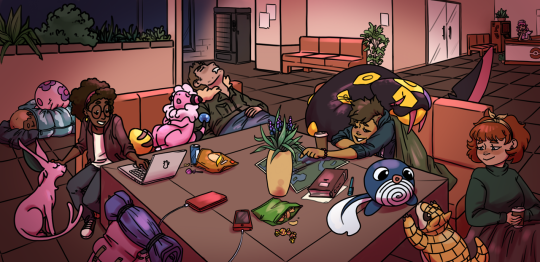
really love imagining a bunch a kids and teens on their pokemon journeys staying the night on the couches and floors in the lobbies of pokemon centers, having long talks about their experiences and feelings sharing funny and scary stories and myths about legendaries and trading items and sharing TMs along with sugary snacks and pokedex chargers all while their pokemon are out of their pokeballs and all bundled up in blankets sleeping soundly next to their trainers while they stare up at the stars shining through the glass ceiling over their heads
someday I will write a pokemon world building fic about fossil revival and how it relates to things like the mew/mewtwo project because it has fascinated me since i was a small child
topics to explore:
–the idea that fossil pokemon are REVIVED, not cloned. what the hell. are they raising the dead? the pokemon that come out the other end are not base level babies, what is HAPPENING there
–the fact that all fossil pokemon are part rock type, apparently because they were revived from stone. how is the process of revival altering them?
–for that matter, pokemon that are rediscovered in the wild like relicanth and kabuto, are they different than revived specimens?
–how did the expedition that brought back mew relate to the fossil reviving labs? are there mew fossils?
–the whole ditto being derived from mew thing, which is my favorite pokemon theory, being a plot centerpiece. possibly a pre-series sort of thing about the creation of ditto.
I would want the protagonist to be a fledgling scientist who is clearly marked as a future pokemon professor by having a plant surname but all the extinct plants are so WORDY.
like Glossopteris is not a great name
REDWOOD his professor name is going to be Professor Redwood.
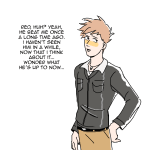
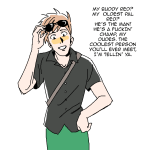
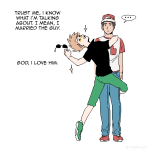
Except it isn’t his last name right now! When we meet him he’s living with his boyfriend, whose last name is Redwood. They’re actually both researchers! Malcolm, our protagonist, is a paleontologist, while his as-of-yet unnamed boyfriend works for Sylph Co working out the bugs in early models of the pokemon healing machine we see in pokemon centers. His specific project is figuring out why they make psyduck headaches worse, so their place is just FULL of psyducks.
Malcolm, introducing himself at his new job with Cinnabar Labs: Hi, my name’s Malcolm, I just moved here with my boyfriend and his ungodly hoard of weird duck pokemon. Yes, that was him trying to herd them all out of the pokemon center on Sunday. We also have a Meowth and a Kadabra but they’re much better behaved, I promise.
The Kadabra speaks some sign language and while he’s technically Malcolm’s boyfriend’s pokemon, he’s so smart they consider him more of a family member. The Meowth is Malcolm’s.
The plot follows the early days of Cinnabar Labs’ success with fossil reviving, with Malcolm starting out enthusiastic and gradually finding more and more things that feel wrong leading up to the Mew experiments, at which point things go downhill FAST.
This process starts when they bring back a ton of Kabuto trying to get one to survive the process, and Malcolm brings one of the struggling specimens home to nurse it through the first days. He then promptly gets attached.
I’m naming his boyfriend Grant because using the last names of Jurassic Park characters is really entertaining me, I’m deeply sorry
The lab is empty of people, leaving Malcolm alone with the whirring and rumbling of the machines. The pumps are especially noisy, sucking in fresh seawater to feed into the heater. It’s attempt number four at creating survivable conditions for the Kabuto in the tanks, going for a natural environment this time. Sterile hadn’t worked, and neither had trying to artificially recreate ancient seas.
The veteran researchers had already given up on this batch, unwilling to work a second all-nighter just to watch another failure play out. They’ll go over the tank footage tomorrow, take readings, examine the dead, and start over.
Malcolm can’t bring himself to follow their example. He’s asleep on his feet and hasn’t seen Grant in two days, but he just can’t leave while any of their test subjects are clinging to life. At least Mitzi is still here to keep him company; his Meowth snores softly from atop the water heater.
There’s only one Kabuto left now, subject 26. It’s not the one Malcolm would have pegged as the most hardy of the bunch, given that it was missing a front claw from the moment they revived it. Still, it’s hanging in there, scuttling in a lopsided loop around the tank.
Malcolm watches as it carefully balances itself on its back legs to spear a chunk of food left on the tank floor. It’s a much slower movement than even the more sickly Kabuto he’s seen try to eat. Malcolm wonders if that’s why this one died the first time, getting outcompeted for food.
Wait.
All the pokemon they’re working with are fossil pokemon, which means they died once already. Healthy, fit pokemon don’t usually just drop dead on the seafloor. Of course all the ones they’re reviving are dying right away, the machines are calibrated to alter them as little as possible for their state at the time of fossilization, a time when they were dying.
He scrambles for the phone, attached to the wall near the door, and calls his home number. It rings for a long while before Grant answers, his voice hoarse with sleep.
“Hello?”
“Babe, it’s me, I need you to–”
“Malcolm, it’s two in the morning–”
“Grant, it’s important, I’m bringing a Kabuto home, I need you to start up your prototype right now.”
“Wait, what?”
“They need medical attention, Grant, that’s why they’re dying, I’m not letting this one die too!”
“Okay, okay! I’ll wake the pokemon, we’ll be ready when you get here.”
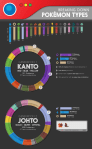
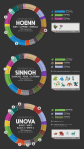
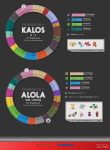
Because compiling data is a thing that I do sometimes, and making things pretty is a thing I do all the time, here’s a nerdy Pokémon infographic breaking down the distribution of types among the different generations.
Interestingly: • Water is far and away the most common type, yet the generation that added the most new Pokémon (Gen V) has the lowest number of water Pokémon. • Gen I has half of all poison Pokémon. HALF. The next closest percentage is 30% of all dark Pokémon in Gen V. • Every generation – even tiny little Gen VI – has the most of at least one type (some are tied for most).
no offense but it’s a whole new world we live in (do do do do do dooo) it’s a whole new way to see (do do do do do doooo) it’s a whole new place with a brand new attitude, but you still gotta CATCH! EM! ALL!! and do the best that you can do




 ruby-dear archive